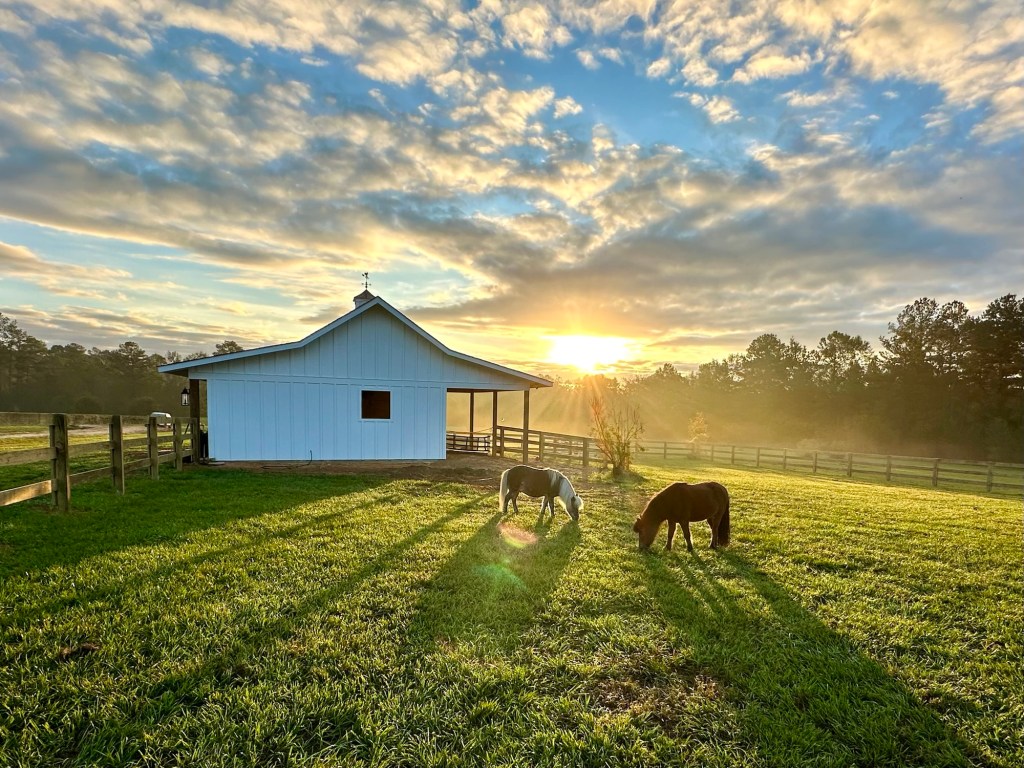
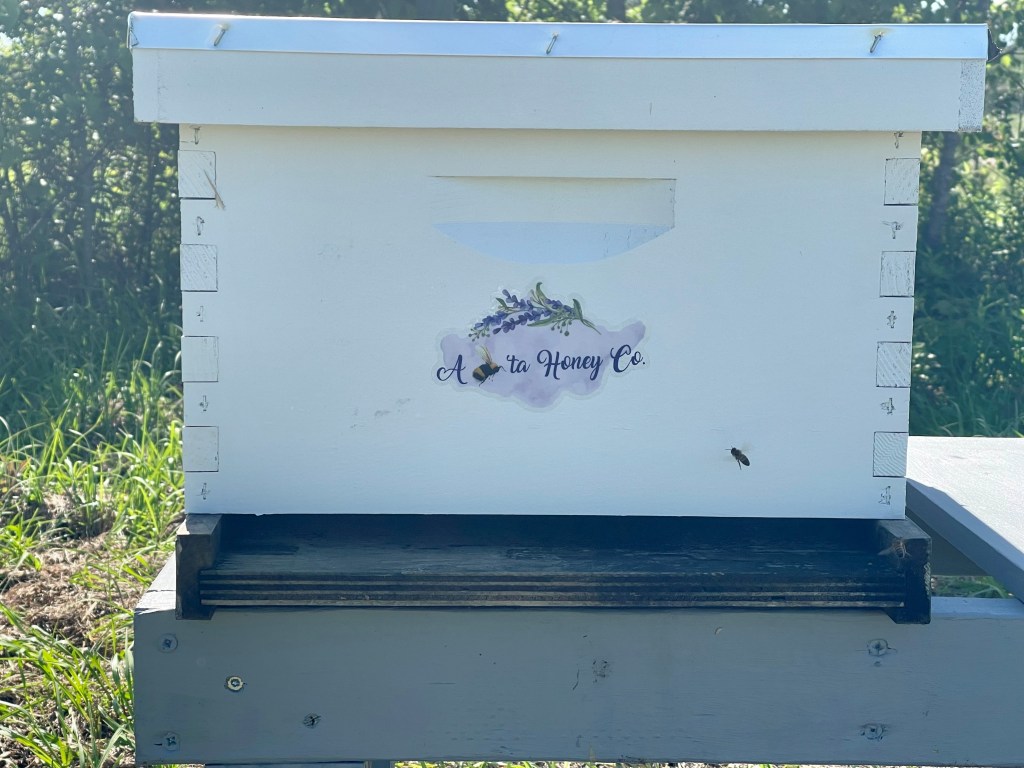
Our little apiary still sits on the edge of the Abita Flatwoods Preserve at Blue Collie Farm. All local. All natural beekeeping methods. It’s been a very abundant year.
In fact it’s been a little too busy to keep up with this site so I invite you to check us out on Facebook where we are AbitaHoneyCo. Or come visit us at the Blue Collie Farm Facebook page if you also enjoy mini horses and chickens. Hope to see you there.
Last week, the Abita Honey Co. bee yard gained two more new hives. This time the new colonies are the product of splits performed by a local beekeeper earlier this spring. In the last blog post we talked about the different ways to start a new hive, and we talked about the possibility of obtaining “nucs” from local beekeepers. This is by far the easiest way to start a new hive. Our two new “nucs” come from a very well established bee yard on the Westbank of New Orleans.
In order to prevent the loss of bees that occurs when a colony divides and a portion “swarms” away to start a new hive, beekeepers perform “splits” of existing hives to help this process along but while retaining the new colony – albeit in a separate hive. The beekeeper who provided our two newest colonies has over 100 hives and performs splits in the spring and sells those new colonies to others looking to expand their bee yard.
The nucs we received and installed last week are all settled in and really multiplying fast. Meanwhile, the swarm nucs installed just one week prior are a little further along in that process. In fact, one of the swarm nucs has already filled its hive box and needed a second deep box installed to allow for continued expansion.
We will likely not be collecting honey from these hives this year as we really want each of these colonies to be fully established in two full deep hive boxes with enough honey for their own use for the winter. If we get lucky and have a longer honey flow this year, maybe, just maybe, our advanced swarm nuc might have enough to share this year but we shall see. The bees come first!
This past weekend we were able to add three new hives to the bee yards. These new hives are courtesy of nucs developed from new swarms. The comparison between these nucs, and a previously installed package of bees is just night and day!
For those new to beekeeping, there are different ways to start a hive. When possible, it’s best to start with a nuc or nucleus which is an already established bee colony on 3-5 frames of foundation. This way, the hive has a good head start with a mated queen, a base of good comb started, and most importantly, a good amount of brood (eggs) already started. Nucs can often be purchased from established beekeepers. For the more industrious beekeepers, nucs can also be obtained by trapping a swarm in the spring. More on that later….
But sometimes, a beekeeper may not have access to a nuc. In that case, a “package” of bees can be purchased from a bee supply company like Mann Lake Ltd. or others. When a beekeeper orders a package of bees, a plastic ventilated box of 10,000 bees (give or take) is shipped via UPS to the beekeeper. It’s actually kind of amazing to receive that buzzing package. I won’t go into the whole process of installing a package of bees, but to sum it up, the beekeeper receives bees and a caged queen who has to be accepted by this colony. The bees are installed in a new hive which typically has no comb drawn out at all. So the bees are starting with nothing. Here’s why that is so challenging for the bees.
The average lifespan of a worker bee is only 4-6 weeks. So a healthy hive must always be producing new workers. A hive started with packaged bees starts with no brood at all, and no frame or comb either. So the bees must first build their comb so their queen has somewhere to lay eggs. The bees also have to immediately start filling comb with food for the colony. Meanwhile, the bees will start to die off as they reach the end of their 4-6 week lifespan. So the first season for packaged bees can be quite a challenge, and a new package should always receive a little extra help with a feeder of sugar water. After all these girls are already stressed and pushed to capacity!
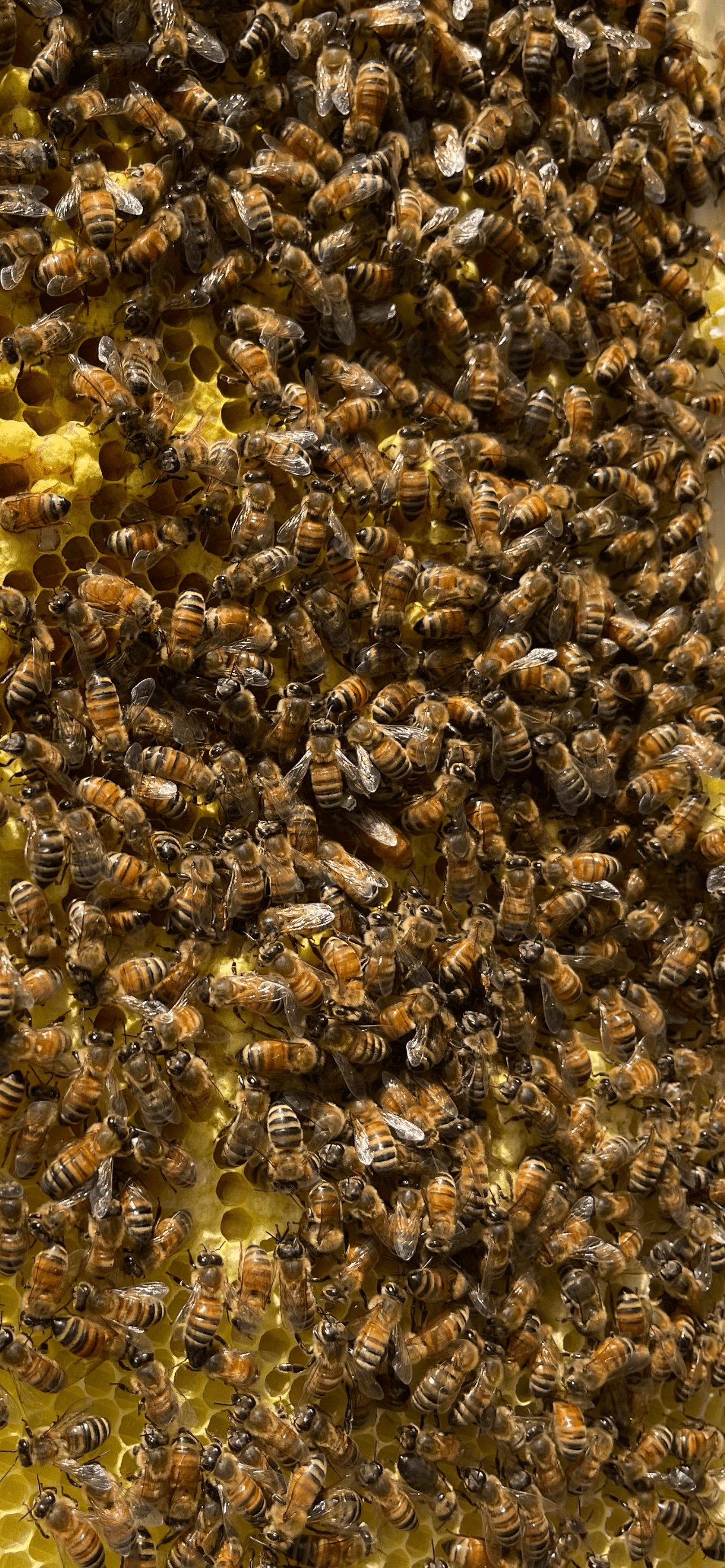
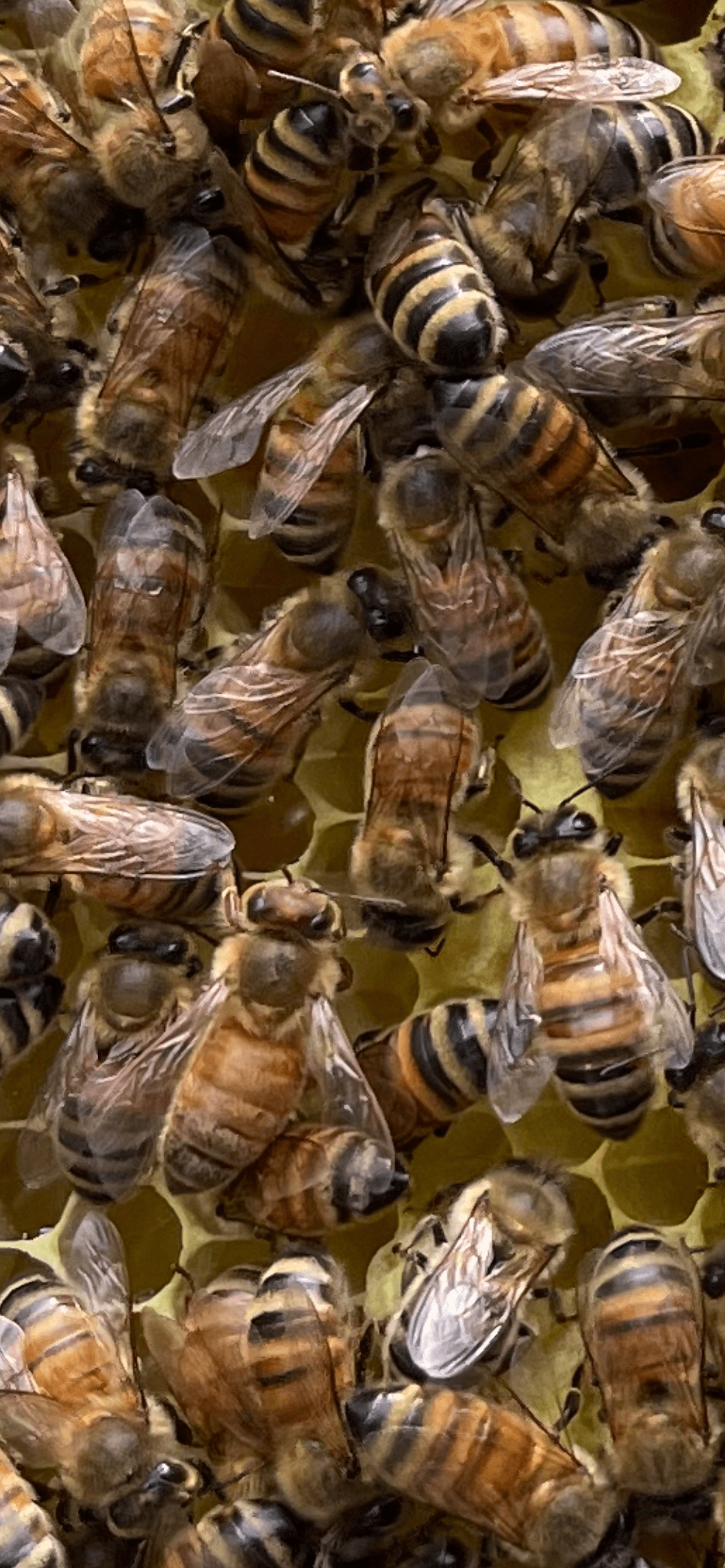
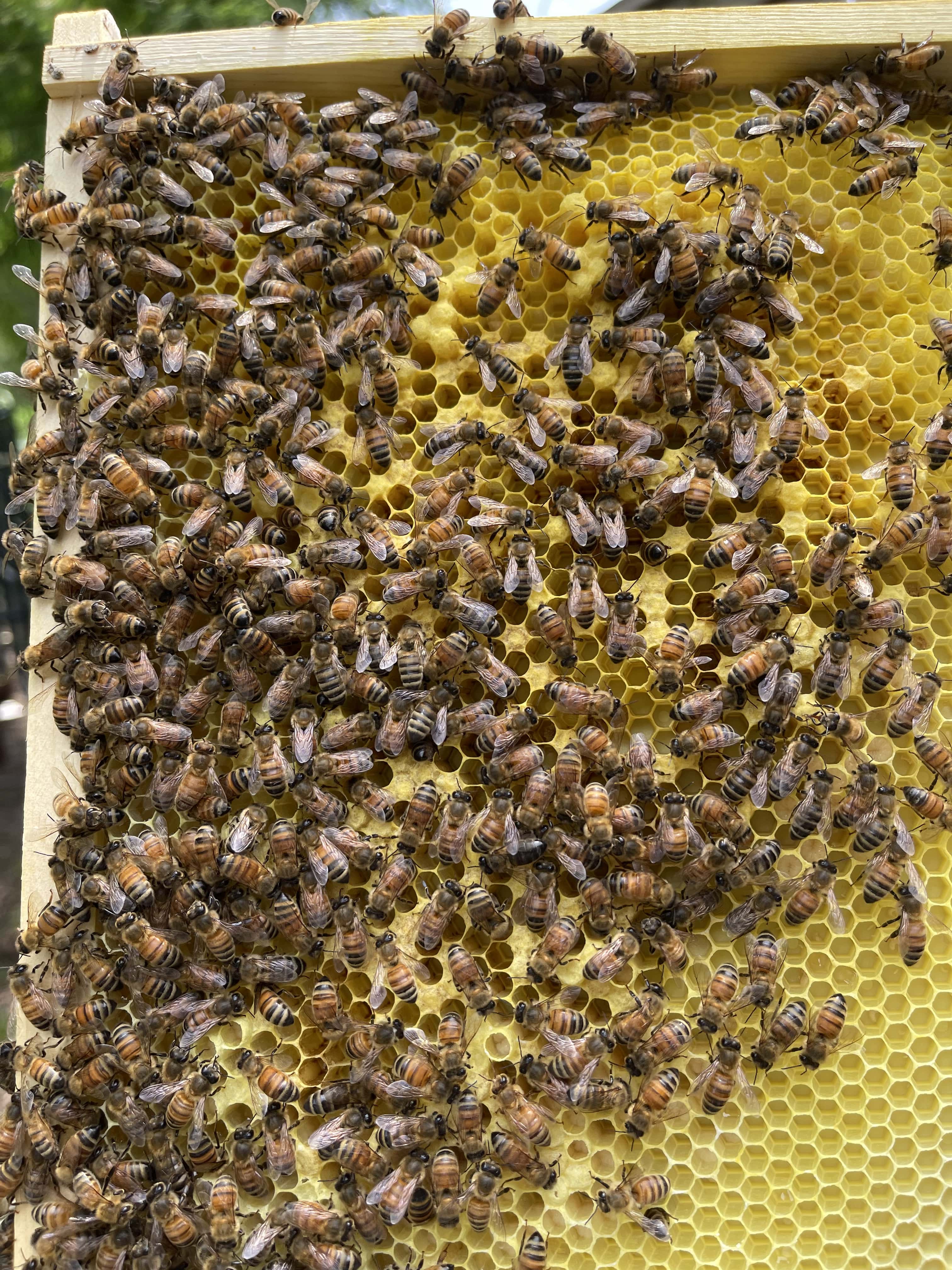
This year, we chose to install a package of purchased bees in one hive. We have had our doubts about that hive from the beginning as these little bees were definitely a bit depleted by the travel. We are supporting them with 1:1 sugar water, and they are holding their own and building comb and brood. It’s just slow going. We do have a healthy queen in that hive, and we are definitely seeing progress. In just under a month we have about four frames of brood, pollen and honey. Here are a few pictures from the “package bee” hive.
Then there are the nucs! The three sets of nucs added last weekend each came with about 4 well established frames containing brood, pollen and honey. Because we wanted to get them settled in without too much disturbance, we don’t have any close ups of those frames, but wow, what a difference.
When we go back in for a full inspection, I’ll add some photos for comparison. We did video the installation of the last nuc just for fun. See below.
From the day they were installed in their respective hives, the nuc bees have been “blowing and going,” and the entrances to those hives are like little bee highways. The nucs have much stronger populations, and many more bees being sent out to forage. It will be interesting to compare the rate of expansion between the hives started with nucs versus our little package experiment.
We are a small bee yard located near the Abita Creek Flatwoods Preserve. Our bees are working hard building up their hives to prepare for the honey flow. The honey flow is that sweet spot in time when the plants are in bloom, and the bees have access to abundant resources allowing the bees to dramatically accelerate the creation of honey within the hive. The two basic requirements for a good honey flow are the accessibility of nectar and suitable weather for flying.
When these conditions are present, we see an increase of activity with the bees flowing in and out of the hive. During the honey flow, it’s possible for a strong hive to gain 5 lbs. or more of honey in a single day. So it’s our job to make sure the bees have room to work and continued access to pesticide free plants and blooms.
We will update this site when we have honey and products for sale at local markets in Abita Springs, Covington and New Orleans. In the meantime, we will post updates on our hives and show you the process.
This site is intended to share our experiences as beekeepers, to encourage others to explore the fun of “keeping” bees, and hopefully to encourage the exchange of information to help us all do the best we can by these amazing little creatures. We don’t pretend to know it all, and we will likely make mistakes along the way. So, if you have feedback, please share it. Let’s keep things positive and constructive. There is so much we can learn from the amazingly unified, cooperative efforts of a hive. Let’s put that bee style spirit in practice here.








 The Abita Honey Co., LLC